

SustainabilityTCFD & TNFD
Tsurumi has been contributing to the global environment and society through water for a century. Both the environment and society, however, are now being threatened by climate change, which could also impact business activities that depend on them. Economic activities also rely on the benefits (ecological services) provided by natural capital such as the atmosphere, water, minerals, soil, plants, and animals, and conserving biodiversity is critical to continue enjoying these benefits.
We have therefore agreed to and endorsed the Task Force on Climate-related Financial Disclosures (TCFD), analyzing climate-related risks and opportunities and disclosing relevant information. The Taskforce on Nature-related Financial Disclosures (TNFD) provides a framework for disclosing information on nature-related risks. Accordingly, we conducted assessments in fiscal 2024 using the LEAP approach*1 to improve resilience.
- *1: An integrated approach to scoping assessments and identifying and evaluating nature-related issues, consisting of four phases: Locate (interfacing with nature), Evaluate (dependencies and impacts on nature), Assess (critical nature-related risks and opportunities), and Prepare (response and reporting).
-
Governance
Board of Directors
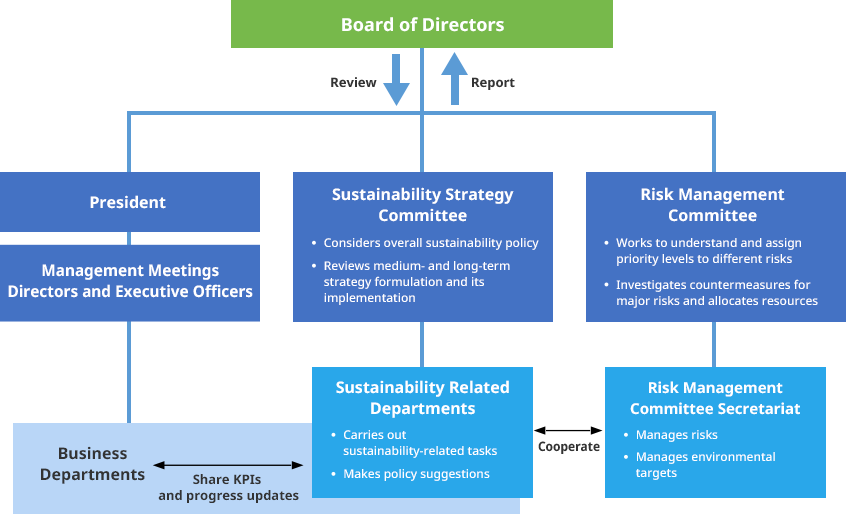
The Board of Directors receives reports from management meetings and committees under its authority, makes decisions on critical sustainability issues related to climate change and nature, and reviews matters discussed and decided by the committees.
The President of Tsurumi, who also serves as the representative of the Board of Directors, is responsible for sustainability-related issues. -
Sustainability Strategy Committee
The Sustainability Strategy Committee was established to deliberate and approve issues and measures connected to sustainability-related risks and opportunities. The Managing Director performs the role of chair and in response to different topics he or she invites executives, employees, and others*2 to form a committee for each (at least once a year). The results of discussions and decisions regarding sustainability issues, such as those related to climate change and nature, are reported to the Board of Directors for review at least once a year.
- *2: Employees, etc., include regular employees, junior employees, non-regular employees, special assignment employees, contract employees, part-time employees, employees on temporary assignment, and dispatched employees.
-
Risk Management Committee
The Risk Management Committee was established to recognize potential risks, and to facilitate close cooperation and information sharing between the Board of Directors and relevant departments. The Managing Director performs the role of chair and in response to different topics he or she invites executives, employees, and others to form a committee for each (at least once a year). The committee acts to evaluate risks, including of improper conduct, and its deliberations and decisions regarding risk countermeasures are periodically reported to the Board of Directors (at least once a year) and reviewed. Where necessary, the committee calls on financial auditors, legal advisors, or similar for advice and guidance.
Governance System for Sustainability-Related Matters
-
Strategies
Climate-Related Matters
When considering our climate change-related strategy, we identify major risks and opportunities and conduct scenario analysis to develop measures that address them.
In our scenario analysis, we referenced the Sixth Assessment Report by the IPCC and the World Energy Outlook (WEO) by the IEA to hypothesize two scenarios in which global temperatures rise by either 1.5°C or 4°C above pre-industrial levels. We then considered the business environment and appropriate response measures under each of those scenarios for 2030.
The scope of the scenario analysis covers our entire value chain (direct operations, and upstream and downstream activities). The Sustainability Strategy Committee reviews the identified risks and opportunities annually. Taking into account both external and internal changes in the environment and information, the committee assesses the risks and opportunities, incorporates its findings into our strategy, and implements corresponding processes.
We conduct this review annually, again taking into account both external and internal changes in the environment and information. The results from the review conducted in fiscal 2024 are as follows.- IPCC: Intergovernmental Panel on Climate Change
- IEA: International Energy Agency
-
Risks and Opportunities Identified
Category Risks Risk Opportunity Details Transitional Policy /
RegulationsCarbon taxes ● - Carbon taxes levied depending on amount of greenhouse gas (GHG) emissions
- Costs incurred to improve carbon footprints, etc.
Changes in the energy mix ● ● - Drop in sales to conventional power generation markets
- Increase in sales for renewable energy power generation
Technology Investments needed in low-carbon technologies ● ● - Difficulty in recovering investment if market trends vary from forecasts
- Increase in sales if successfully able to differentiate products from those of competitors
Market Increased material costs ● - Rise in manufacturing costs as material prices soar due to increased demand
Changes in consumer behavior ● ● - Decrease in sales of conventional products due to increased environmental awareness
- Increase in sales to environmentally aware customers
Reputation Perception of lack of efforts on global warming ● ● - Loss of corporate reputation
- Boost to corporate reputation through proactive efforts
Perception of insufficient disclosure ● ● - Drop in external ratings
- Improved external ratings through appropriate information disclosure
Physical Chronic Rise in average temperatures ● ● - Drop in productivity due to worsening working conditions
- Costs incurred to improve working conditions
- Increased productivity by improving working conditions
Acute Increasing severity of abnormal weather ● - Halt to operations due to damage to company assets or supply chain interruptions
Main Opportunities Increasing sales of energy-efficient products We can increase sales if we can cater to demand for products that help to reduce GHG emissions during use. Providing carbon footprint data We can cater to environmentally aware customers’ needs by calculating the GHG footprint produced during manufacture. Adapting to new power generation markets We can capture sales opportunities by pivoting to markets in geothermal power generation or new technologies. Catering to increased flood defense needs We can increase sales by responding to demand for BCP countermeasures and more functional/updated wastewater equipment. Constructing component production systems We can earn a strong reputation for reliability during uncertain circumstances by producing important components in-house. GHG: Greenhouse Gas
-
Scenario-Based Evaluation and Countermeasures
Hypothetical Climate-Related Scenarios
1.5°C Rise Scenario (referencing the IPCC’s SSP1-1.9 and SSP1-2.6 scenarios and the IEA’s NZE scenario)
This imagines strict regulations being introduced and technical innovations made with the aim of achieving net-zero global GHG emissions and so the main business impacts are the result of changes to markets and customers’ preferences as society transitions to a decarbonized world.4°C Rise Scenario (referencing the IPCC’s SSP3-7.0 and SSP5-8.5 scenarios and the IEA’s STEPS scenario)
This imagines global efforts to tackle climate change being disparate and inconsistent, and regulations and technical innovations insufficient and so the main business impacts are the result of changes to society triggered by climate change in the form of rising temperatures and heavy rainfall.Periods Used in Identifying and Evaluating Climate-Related Risks and Opportunities Period Details Short-term FY2024–2026 The activity period for our three-year medium-term management plan Medium-term Until the end of FY2029 The final year of our long-term management plan and the end point for our current long-term environmental targets Long-term FY2030 and beyond The period after our long-term management plans Financial Impacts Definition Minor An impact with little effect on our business activities Moderate An impact with an effect on only part of our business activities Major A negative impact that would interrupt or reduce business activities or a positive impact that would significantly boost sales -
Major Risks and Opportunities Identified via Scenario-Based Analysis, and Countermeasures
Risks
Risk OpportunityValue Chain Financial Impacts Countermeasures Time Span - Introduction of carbon taxes
- Perception of lack of efforts on global warming
- Perception of insufficient disclosure
Direct operations Minor Reducing GHG emissions from our own activities (Scope 1 and 2)Carbon taxes may be introduced under the 1.5°C scenario. As business growth leads to increased GHG emissions from manufacturing products, such taxes may negatively impact profits if introduced. Moreover, regardless of the introduction of carbon taxes, failure to reduce GHG emissions may harm our reputation and impact profits.
To address these risks, we announced our Green Plan 2030 both internally and externally. This plan states that our long-term environmental goal is to reduce GHG emissions from our own activities by 50% by 2030 compared to fiscal 2014 levels. Specific measures to achieve this goal include switching to LED lighting, installing solar power generation facilities, switching to electric or hybrid vehicles, and electrifying heating systems. We will contribute to mitigating climate change by expanding our emission reduction efforts and implementing other effective measures while minimizing the risks we face.Short- to long-term - Investments needed in low-carbon technologies
- Increasing demand for energy-efficient products
Direct operations Major Meeting diverse needs by expanding our product lineupThe possible impacts of climate change on the pump market include a shift toward water-resistant products in fields where surface pumps are used, as well as increased demand for pumps equipped with high-performance motors. We anticipate rising demand for our products at geothermal and biomass power plants will lead to an increase in net sales. However, as product specifications that meet these needs vary by region, a broader product lineup is required to address the diverse requirements in each country.
Since fiscal 2019, we have maintained a technical and business partnership with ZENIT, a company with a competitive edge in the industrial facility market. Through this partnership, we have complemented and strengthened our product lineup, promoted sales through both companies’ sales networks, and developed new products by combining our technological capabilities. In fiscal 2024, ZENIT became our consolidated subsidiary. Moving forward, we will further capitalize on sales and technical synergies to meet needs in diverse markets and drive sales growth.Short- to long-term - Changes in the energy mix
- Adapting to new power generation markets
Downstream Moderate Keeping track of trends and demand in the electricity marketAs progress in digital transformation (DX) and green transformation (GX) is expected to increase electricity demand, the electricity market must ensure a stable energy supply while promoting decarbonization. This effort could lead to a variety of scenarios, as outlined in the Shared Socioeconomic Pathways (SSPs).
Regarding sales opportunities for our products, the decline in fossil fuel-reliant power generation on the path toward net zero may adversely impact our profits. However, we expect to see short-, medium-, and long-term demand in conventional renewable energy markets such as geothermal, biomass, and solar power. We anticipate rising demand for vacuum pumps in geothermal and biomass power generation and submersible pumps used in the rainwater retention basins associated with solar power generation. We believe this will lead to an increase in net sales.
For example, measures against flooding in solar power generation facilities require selecting the appropriate pumps for each location, including those that support high head and large flow applications. Geothermal power generation uses liquid ring vacuum pumps while biogas power generation employs products with outstanding solid-passing capabilities and energy-efficient water treatment equipment to minimize the consumption of the generated electricity. We will continue to serve these markets while allocating resources to address emerging markets and technologies for zero-emission thermal power generation, where we anticipate long-term growth in demand. This approach aims to reduce risks and capture opportunities throughout various foreseeable situations. We also foresee demand for CCU, CCUS, and other new technologies, and will closely monitor those markets.Short- to long-term - Catering to increased flood defense needs
Downstream Moderate Increasing demand in Japan driven by greater rainfall intensityRainfall intensity in Japan is projected to increase by 10% by 2030. Accordingly, we anticipate an increase in orders for our products that support business continuity planning (BCP) strategies and other adaptation measures that address the acute physical risks arising from climate change in Japan, which may lead to increased sales of our products. We expect this will primarily increase orders for our stormwater drainage system products and related construction work projects.
In particular, we anticipate a shift to an environment more conducive to winning orders in government agency projects thanks to the increase in the number and total value of projects for upgrading and strengthening the functionality of stormwater drainage facilities. For instance, in the Tokyo metropolitan area, numerous projects are planned to upgrade aging pump stations with 1,500- to 2,000-mm bore sizes to non-primed advance standby vertical shaft mixed-flow pumps. We expanded our production facilities, including testing equipment, in fiscal 2020 and 2021 as capital investment to obtain authorization to manufacture these pumps. We will continue to propose solutions using our existing product lineup and knowledge to win projects. In addition, we will enhance our product development and service and support structure to respond to diversifying needs. Furthermore, in overseas markets where economic growth is expected, we aim to expand sales by monitoring the impact of climate change and market trends as well.Short- to long-term - Changes in consumer behavior
- Providing carbon footprint data
- Sales opportunities for environmentally conscious customers
Direct operations Minor Offering a lineup of products that help reduce GHG emissions during useExpanding our lineup of products that help reduce GHG emissions during use helps attract environmentally conscious customers and, ultimately, leads to increased sales. For example, electrode-type automatic submersible pumps equipped with water level detection sensors, which are frequently used at construction sites, reduce idling. In turn, this can be expected to reduce GHG emissions proportionate to the reduced unnecessary operation time. Moreover, our smashing cutter pumps, used for sewage and wastewater treatment, feature high efficiency and excellent solid-passing capabilities with a new mechanism incorporated, making them help to reduce GHG emissions. We will leverage the strengths of these products to capture sales opportunities and calculate our carbon footprint to flexibly align with changing customer behavior. Short- to long-term - Increasing severity of abnormal weather
- Increased material costs
- Constructing component production systems
Upstream
DownstreamMajor Strengthening the supply chain to mitigate procurement risks and build a stable supply structureWe use simulations of inundation and flood damage based on hazard maps to calculate the expected costs. Under both the 1.5°C and 4°C scenarios, the temperature rise by 2030 is predicted to be 1.5°C, and the frequency of heavy rainfall events with more than 50 mm of precipitation per hour is expected to increase to approximately 1.5 times the level observed 30 years ago. While our products are playing an increasingly important role in mitigating heavy rain disasters, the risk of supply chain disruptions affecting our products is also growing. If heavy rain or flooding causes temporary production or shipment stoppages at our plants or disrupts our upstream or downstream supply chains, we could face a decline in sales due to lost manufacturing and sales opportunities.
Since fiscal 2023, as a measure to address the risk of supply interruptions from suppliers, we have invested approximately 10 billion yen in the Innovative Manufacturing (Kyoto) 2030 project and advanced capital investments to strengthen our production structure, including the Motor Production Building. The in-house production of key components reduces reliance on external procurement and diversifies procurement risks. Additionally, we have invested approximately 1 billion yen in Alloy Technology, one of our group companies, to establish an integrated production structure by introducing new processing facilities for high-precision stainless steel and high-chrome cast iron. Moreover, as a measure to address the risk of disruptions to the supply of products from our company, we established a logistics base in Utsunomiya City, Tochigi Prefecture in 2020. This facility can supply products even if our existing production and shipping bases in our plants become inoperable, thereby diversifying risk. Through these investments to bring our supply chain in-house, we are striving to mitigate procurement risks and build a stable supply structure.Short- to medium-term - Rise in average temperatures
Direct operations Moderate Boosting productivity and improving workplace conditionsBoth the 1.5°C and 4°C scenarios predict deterioration in working conditions due to rising temperatures, posing threats to productivity and safety.
The Innovative Manufacturing (Kyoto) 2030 project, underway since fiscal 2023, involves integrating unmanned processing technology based on a flexible manufacturing system (FMS). This enhances the productivity of our existing production system and helps mitigate the impacts of rising temperatures on workplace conditions.
Meanwhile, our casting business uses 3D sand casting technology to improve yield and produce sand molds that closely match design drawings, thereby reducing the number of post-processing steps. These efforts aim to increase overall productivity, create a stable production system, and improve workplace conditions.Short- to medium-term As part of our efforts to mitigate climate change, we have calculated our Scope 1 and 2 emissions and identified the GHG emission sources with the greatest impact. In addition, we have integrated our long-term environmental goals and specific emission reduction measures into our environmental management system. In terms of sales, we have determined that adapting to climate change will lead to an increase in sales opportunities. While continuing to focus on our existing markets, we will monitor the growth of those markets and track trends in emerging markets to allocate our resources appropriately. On the manufacturing side, we expect ongoing investment plans to improve productivity and reduce procurement risks. On the technical front, we already offer a lineup of products that help reduce GHG emissions and meet customer preferences. Based on these analysis results, we have determined that we are highly resilient under both the 1.5°C and 4°C scenarios.
Moreover, through our research and development activities, we bring to the market low carbon technologies and products that reduce environmental impact. In doing so, we contribute to the sustainability of society as a whole with products that help our customers to mitigate and adapt to climate change and reduce emissions. -
Nature-Related Matters
Fiscal 2024 assessments were conducted for domestic sectors directly operated by our group companies and for regions where our group companies’ plants are located. For the former, ENCORE*3 was used to identify the dependencies and impacts of applicable industries on nature, of which a heat map was created. For the latter, the Aqueduct Water Risk Atlas*4 was used to assess the significance of water-related risks. Results indicate that Shanghai is the only location where a plant is situated in a region with a water stress level of ‘medium or greater.’
The heat map of potential impacts suggests the possibility of noise and oil seepage. While compliance with relevant laws and regulations is a prerequisite, potential risks are identified and monitored through daily operations, including regular inspections and routine business activities.
Regarding water-related risks, the Shanghai plant has been identified as a high-risk location, requiring BCP measures as in the past. However, the potential impacts are currently considered minor, as the plant does not use water in its manufacturing processes.- *3: A tool to help users assess their dependencies and impacts on nature
- *4: A mapping tool provided by the World Resources Institute (WRI) to help users assess and visualize water-related risks worldwide.
-
Identification Results Regarding Dependencies and Impacts of the Operations Concerned (Heat Map)
Operations Dependencies Impacts Air purificationFlood mitigationRainfall pattern adjustmentSevere storm mitigationWater flow controlWater purificationFresh water supplySoil and land conservationNoise, light pollutionNon-GHG air pollutionGHG emissionsWater and soil pollutionWater usePump manufacturing Motor manufacturing Casting - : High
- : Medium
- : Low / None
-
Risk Management
The Sustainability Strategy Committee and the Sustainability Related Department, which serves as the committee’s secretariat, take the lead in identifying, assessing, and responding to climate change-related risks and opportunities, nature-related risks and opportunities, and dependencies and impacts.
As the secretariat to the committee, the Sustainability Related Department extracts and identifies risks, opportunities, dependencies, and impacts across the entire value chain, including direct operations and upstream and downstream activities. In this process of extraction and identification, the department uses resources such as the World Energy Outlook (WEO) by the International Energy Agency (IEA), the Sixth Assessment Report by the United Nations Intergovernmental Panel on Climate Change (IPCC), Aqueduct by the World Resources Institute (WRI), and various hazard maps by the Ministry of Land, Infrastructure, Transport and Tourism (MLIT), as well as the company’s in-house data. Extracted items are analyzed qualitatively and quantitatively to estimate the potential impacts based on the relevant time horizons (short-, medium-, and long-term). This process is conducted every fiscal year.
Furthermore, the department conducts scenario analyses on climate change-related risks and opportunities under both the 1.5°C and 4°C scenarios to assess the key risks and opportunities, and then formulate measures to address them.
Meeting at least once a year, the Sustainability Strategy Committee again discusses and assesses the identified and assessed items, and then reports the results to the Board of Directors. Similarly, the Risk Management Committee also assesses business risks and periodically (at least once a year) reports its findings to the Board of Directors.
Based on reports from these committees and considering sustainability initiatives, the Board of Directors appropriately oversees the allocation of management resources and the execution of strategies by deliberating and formulating corporate strategies such as our medium-term management plan.
-
Indicators and Targets
The climate-related indicators we have chosen to evaluate our performance are reductions (in percentage terms) to the amount and intensity of the GHGs we emit. We have published our targets in our Green Plan 2030, and are working in various ways in our corporate activities to reduce GHG emissions.
Nature-related indicators and targets will be established, with key indicators identified based on analysis results. Trends in GHG emissions, as well as performance and volumes of water intake and discharge relative to targets, are presented in the ESG data sheet on our website.
-
Green Plan 2030
- Reduce the amount of greenhouse gases emitted from our activities to 50% of the level in FY2014 by FY2030.
- Reduce the intensity of greenhouse gases emitted from our supply chain activities by 30% of the level in FY2014 by FY2030.
GHG emission reduction activities and assessment by external parties FY2022 FY2023 FY2024 -
Scope1
Switching to hybrid vehicles*5: Approximately 23 tCO2eq
Electrification of heating systems at the Yonago Plant*6: Approximately 7 tCO2eq -
Scope2
Addition of sites using renewable energy*7,8: Approximately 48 tCO2eq
Tokyo Head Office, Shikoku Branch Office, Takasaki Sales Office - Assessment by external parties CDP “Climate Change”: C
-
Scope1
Transitioning to electric/hybrid vehicles*5: Approximately 30 tCO2eq
Electrification of heating systems at the Yonago Plant*6: Approximately 52 tCO2eq - Scope2 Installation of solar power generation facilities at Chubu Branch Office*9: Approximately 7 tCO2eq
- Assessment by external parties CDP “Climate Change”: B-
- Scope1 Switching to hybrid vehicles*5: Approximately 8 tCO2eq
-
Scope2
Installation of solar power generation facilities in the motor manufacturing facilities at the Kyoto Plant*10: Approximately 340 tCO2eq
Installation of solar power generation facilities at the Kinki Branch Office*10: Approximately 5 tCO2eq - Assessment by external parties CDP “Climate Change”: B
GHG emission reduction activities and assessment by external parties FY2022 -
Scope1
Switching to hybrid vehicles*5: Approximately 23 tCO2eq
Electrification of heating systems at the Yonago Plant*6: Approximately 7 tCO2eq -
Scope2
Addition of sites using renewable energy*7,8: Approximately 48 tCO2eq
Tokyo Head Office, Shikoku Branch Office, Takasaki Sales Office - Assessment by external parties CDP “Climate Change”: C
FY2023 -
Scope1
Transitioning to electric/hybrid vehicles*5: Approximately 30 tCO2eq
Electrification of heating systems at the Yonago Plant*6: Approximately 52 tCO2eq - Scope2 Installation of solar power generation facilities at Chubu Branch Office*9: Approximately 7 tCO2eq
- Assessment by external parties CDP “Climate Change”: B-
FY2024 - Scope1 Switching to hybrid vehicles*5: Approximately 8 tCO2eq
-
Scope2
Installation of solar power generation facilities in the motor manufacturing facilities at the Kyoto Plant*10: Approximately 340 tCO2eq
Installation of solar power generation facilities at the Kinki Branch Office*10: Approximately 5 tCO2eq - Assessment by external parties CDP “Climate Change”: B
- *5: Calculated based on the expected GHG emission reductions per vehicle and the number of vehicles replaced.
- *6: Amount of GHG emissions avoided due to reduced heating oil consumption in fiscal 2023 (compared to fiscal 2022 levels), allocated in proportion to the number of instruments introduced in the year concerned.
- *7: The balance between the actual amount and the amount calculated using the emission coefficient (for reporting in fiscal 2023) for the contracted electricity before switching to renewable energy.
- *8: Business locations that used renewable energy in or before fiscal 2022 include the Osaka Headquarters, the Tohoku Branch Office, and the Kita-Kanto Branch Office.
- *9: Calculated using the actual amount of electricity generated and consumed in fiscal 2024 and the emission coefficient of contracted electricity (for reporting in fiscal 2025).
- *10: Calculated using the estimated amount of electricity to be generated and the emission coefficient of contracted electricity (for reporting in fiscal 2025).

